An expense can be predictable without being monthly. A renewal, seasonal household purchase, or recurring annual obligation may disappear from attention because it is absent from most monthly bills. When it finally arrives, the amount can look like a surprise even if the event itself was foreseeable. The useful response is to give that expense a place on the calendar before its payment month.
Start with the next occurrence you can reasonably identify. Write what it is, the current expected date, and how you know the amount. Separate a quoted or billed figure from an estimate based on last year. Do not turn an old amount into a current price merely because it is the only number you have. Add a date for verifying it through the relevant official source.
Separate preparation from payment
The payment date is one point. Preparation may involve several earlier decisions: whether the service is still needed, whether alternatives should be compared, whether a cancellation or renewal deadline applies, and what money could be assigned over time. Each question has its own useful timing. A reminder on the payment date alone cannot make an earlier choice available again.
In a fictional example, a household expects a recurring expense of about $240 in twelve weeks. Dividing $240 by twelve produces a simple $20-per-week planning illustration. It does not establish that the household can afford that assignment, that the actual amount will remain $240, or that a particular card offers a savings feature. The arithmetic describes one hypothetical plan and its assumptions.
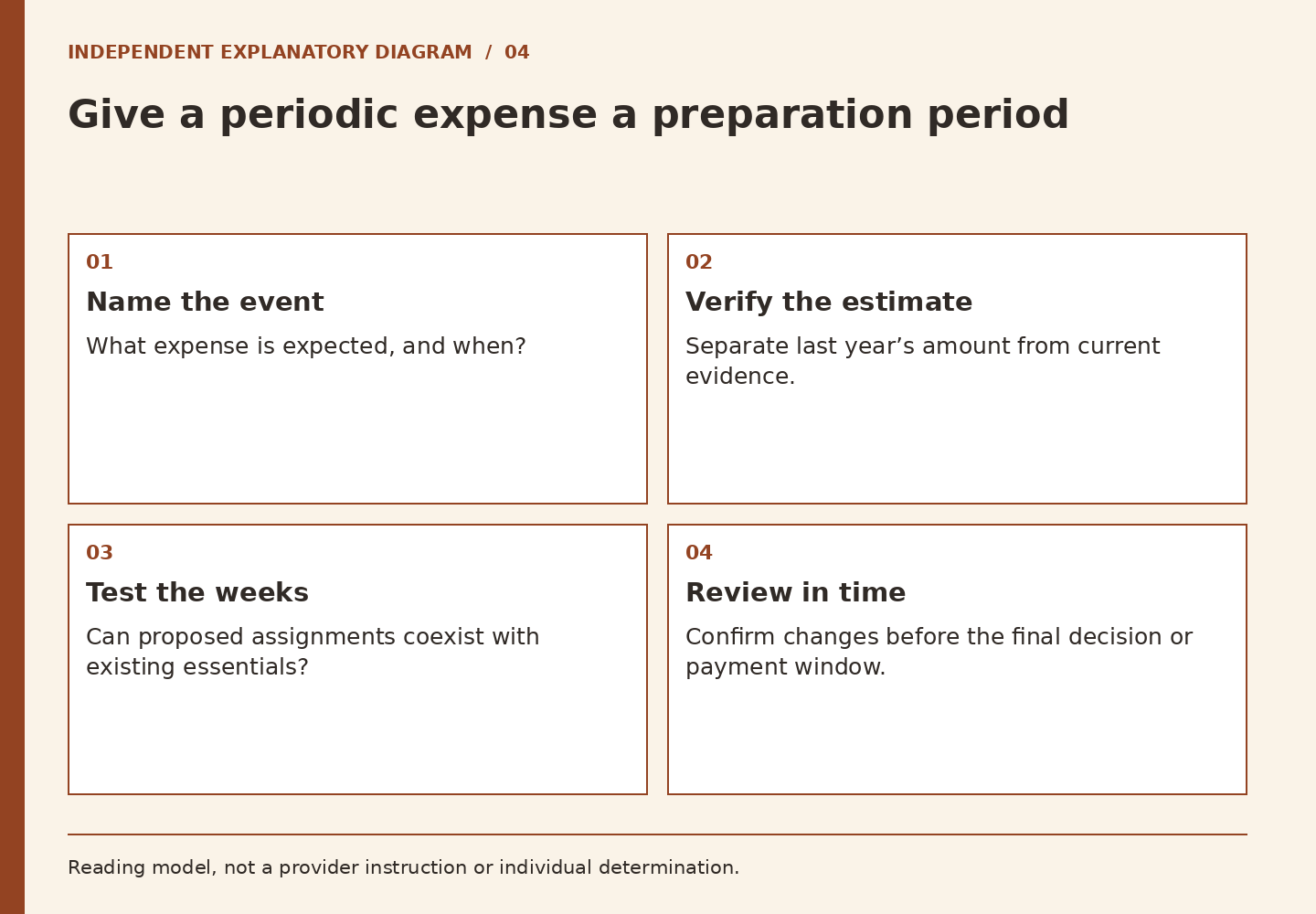
Test the assignment against real weeks
Place the proposed weekly assignments beside existing obligations. If several weeks already show a shortfall, equal amounts may not fit. You might need to investigate a different expense, a different timing arrangement, or other support. Merely replacing one large number with twelve small numbers does not create additional resources. Keep any unresolved gap visible rather than labeling the expense fully prepared.
Consider whether the amount belongs in a household reserve label or an existing suitable financial arrangement you already use. This article does not recommend opening an account or moving funds. If changing where money is held would involve terms, restrictions, fees, or access delays, assess those separately with the responsible provider before relying on the change.
Recheck the event before the last week
Choose a checkpoint early enough to discover a changed amount or date. A renewal notice may provide information that was unavailable when you first planned. Update the estimate from that evidence. If you decide not to continue a service, follow its actual cancellation process and confirm the outcome; removing the expense from your notebook does not itself end a contract or stop a charge.
If the expense is necessary but the preparation period is already short, focus on the remaining choices rather than judging the past. Verify the actual amount and deadline, identify the gap, and ask the appropriate organization about available options. Do not assume that splitting a payment or postponing it is allowed. An arrangement needs explicit confirmation of its terms and timing.
After the event, keep a short note for the next cycle: the actual amount, the first useful reminder date, and any decision that needed more lead time. That record can make next year’s planning easier without pretending that next year’s prices or terms are already known. The goal is earlier visibility, not a perfect forecast.
Sources and reading boundaries
Sources checked October 7, 2026. This is a review date, not a policy effective date or an account test.
- CFPB: Planning for life events and large purchases: General value of naming an upcoming event, timeframe, and associated costs. 2018 educational worksheet. No credit recommendation, cost estimate, inflation assumption, or savings target adopted. Review basis: Official PDF text reviewed, three pages.
- CFPB: Improving cash flow: General idea of asking about due-date changes, periodic expenses, and income-expense timing. Older worksheet contains other policy-sensitive topics. Tax, loan, assistance, eligibility, and prepaid savings-feature examples are not carried forward as current advice. Review basis: Official PDF text reviewed, six pages.