An account can show money that your household has already mentally assigned to next week’s rent, transportation, or another obligation. That assignment matters for planning, but it does not necessarily create a separate account feature. Calling it a reserve is useful only if everyone understands that it is a label in your household plan, not a promise that the card provider has protected or separated those funds.
Start by choosing one place to record those assignments. It might be a notebook beside the bill calendar or a private spreadsheet that you maintain. The important feature is consistency. Two lists that both subtract the same future bill can make the household seem shorter than it is. Two people who each assume the same money is unassigned can create the opposite problem.
Name the job before the number
For each reserve, write what it is for, when the money is expected to be needed, and whether the amount is fixed or estimated. “Transportation until Friday” answers a different question from “annual expense later this year.” An estimated amount should remain visibly estimated. Do not describe a reserve as fully covered merely because you intend to add money to it after another paycheck.
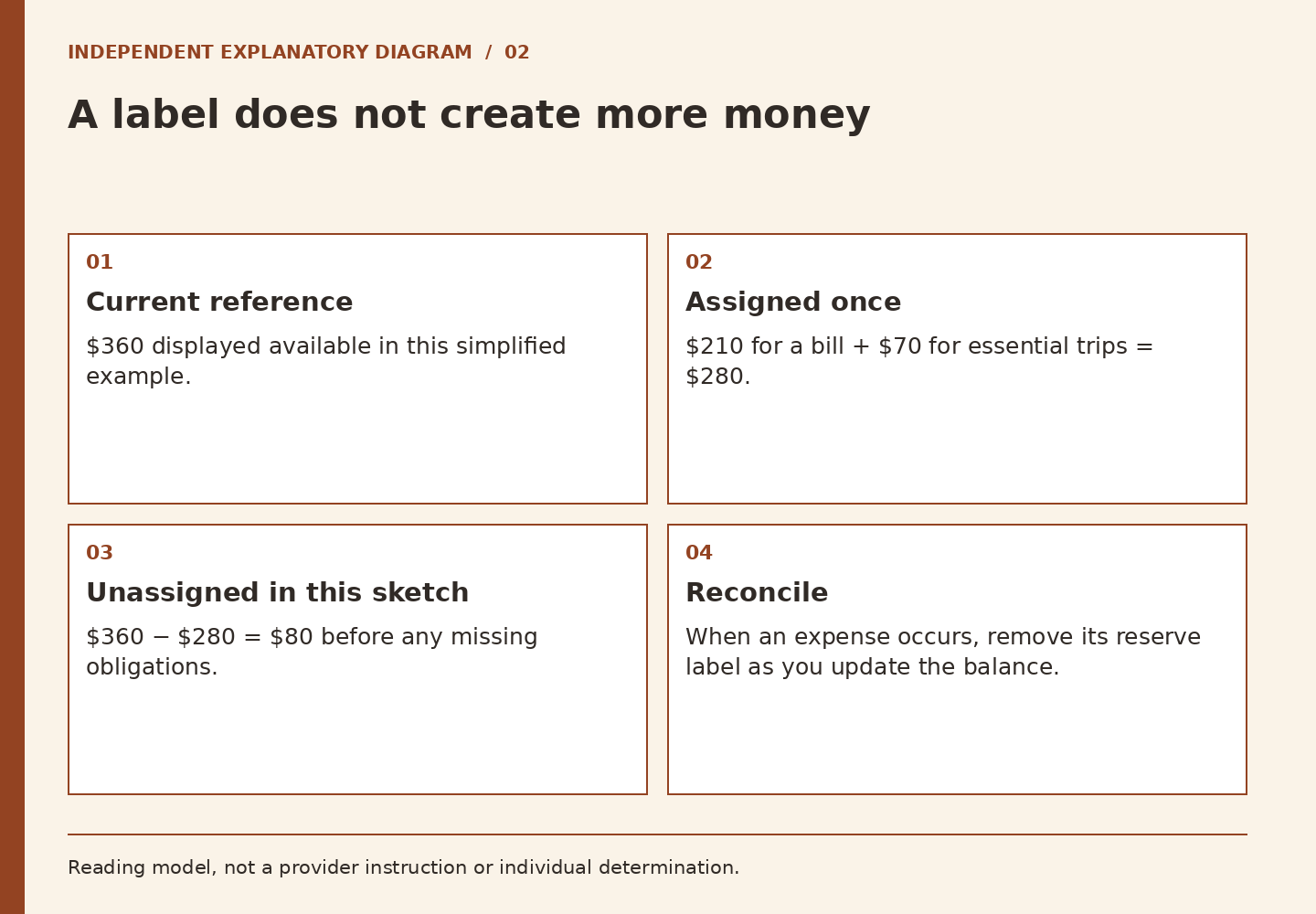
A reserve can also be partial. In a fictional example, an account shows $360 available at the moment you check it. The household has assigned $210 of that amount to a known bill and $70 to essential trips before the next expected income. The arithmetic leaves $80 unassigned within this simplified plan. That is not a safe-to-spend guarantee: other obligations, transactions, and access constraints may still be missing.
Reconcile assignments with actual changes
When the $210 bill is actually paid, remove its assignment as you update the plan from the account’s current information. Otherwise the reduced account balance and the still-present reserve could both represent the same outflow. If a bill’s amount changes before payment, change its assignment rather than adding a second reserve with an almost identical name. Keep a brief explanation when a revision would otherwise be confusing.
Do not subtract an account hold again simply because you see it in your notes. First determine how it is represented in the current available figure through the official account information. This journal cannot interpret an individual account screen. If you cannot reconcile the numbers, mark the uncertainty and ask the provider rather than treating the most comfortable result as correct.
Decide what happens when plans compete
A new expense may require discussing whether an existing assignment should change. Make that choice explicit: which obligation would be less covered, when would the gap arise, and who needs to be contacted? Moving a label on paper does not cancel the original bill. If available resources cannot cover important needs, bring the shortfall into view and seek relevant help instead of hiding it behind a renamed category.
For a shared household, agree on the level of detail that is useful. A note saying “next week’s essentials reserved” may be enough for a planning discussion. It does not require sharing credentials, card numbers, or a full transaction history. Each adult retains control over their own accounts; this method is about coordinated expectations, not account authority.
Close each review with a simple check: every assignment refers to a real purpose, every amount is counted once, and any uncertainty is visible. There is no universally correct reserve size in this article. A clear, modest plan that admits a gap is more useful than a polished total that accidentally counts money twice.
Sources and reading boundaries
Sources checked October 7, 2026. This is a review date, not a policy effective date or an account test.
- CFPB: Creating a cash flow budget: General educational model relating resources and expenses over successive periods. 2018 worksheet; our event-level calendar and reserve labels are original, not a provider balance calculation or copied CFPB tool. Review basis: Official PDF text reviewed, four pages.