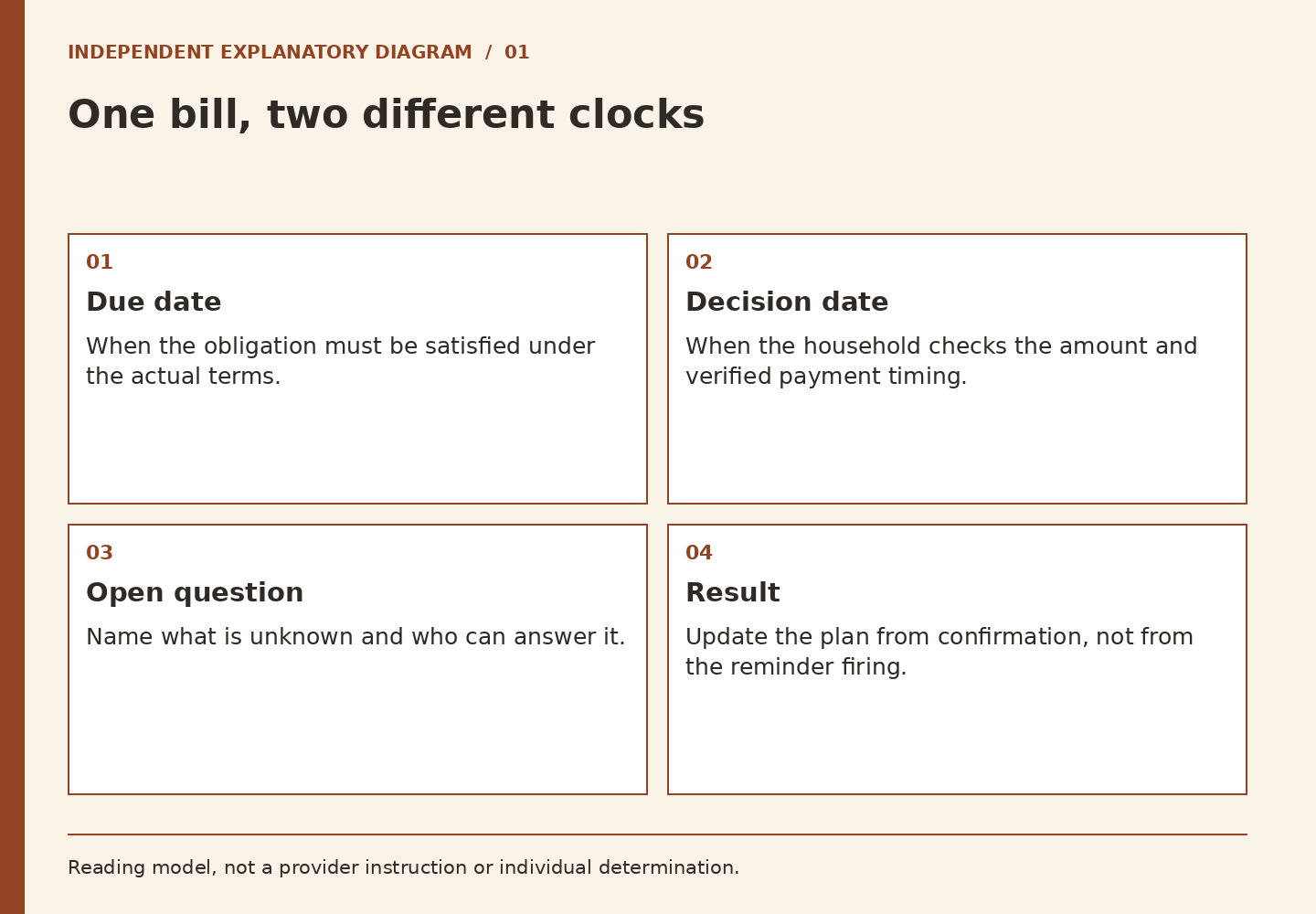
A bill calendar becomes more useful when it shows when you need to act, not just when something is due. A due date belongs to the agreement with the biller. A decision date is a household reminder to check the amount, the payment method, and the resources expected to be available. Treating those dates as identical can leave no room to resolve a missing detail.
This journal is written for households using Fintwist-related wage cards as one part of their money routine. The provider’s current public name is Corpay Prepaid. That name does not set your payday or a biller’s processing rules. The calendar below is an original household exercise, separate from the provider’s services and from any payment instruction.
Start with the obligation
For each bill, record a short label, the amount or an honest estimate, the stated due date, and the place where you can verify it. A paper sheet can say “electricity” without showing an account number. If the amount is unknown, mark it unknown rather than copying last month’s total as though it were confirmed. Keep the underlying bill in its usual secure place.
Next, find the payment method’s actual timing requirements. The date you send a payment, the date it leaves an account, and the date the biller treats it as received may differ. Ask the biller or the relevant provider if those details are unclear. Do not use a universal number of days from a blog, an old worksheet, or a friend’s different payment service.
Place the household reminder
Choose a decision date that leaves enough time for the verified method and for a realistic opportunity to resolve a question. This is a planning choice, not permission to change the bill’s due date. Someone who works during service hours may need a reminder before their next free morning. Someone waiting for a variable invoice may need an initial estimate check and a later confirmation.
In a fictional example, a household has a bill due on the eighteenth. Its chosen method requires timing the household has checked with the biller. The calendar therefore includes a reminder before that method’s cutoff: confirm the final amount, check accessible funds, and verify which payment is scheduled. If the reminder reveals a problem, the next step is a prompt conversation with the biller, not simply moving the due-date label forward.
Show what the reminder accomplished
Use a short status beside the decision date: amount checked, question sent, arrangement confirmed, or payment needs attention. Avoid one vague check mark meaning all four. A reminder that fired is not proof that a bill was paid. Likewise, a planned payment date is not a confirmation that the payment happened. Your calendar needs enough distinction to reveal unfinished work.
Add a second person’s task only when that person has agreed. “Ask about electricity amount” is different from “partner will handle electricity.” A shared calendar can identify who will make an inquiry without granting access to a card account or revealing private account details. If nobody owns a task, name that gap while there is still time to address it.
At the next weekly review, inspect the space between the decision date and the due date. Was it workable? Did a question remain unanswered until the last moment? Adjust the next reminder based on that experience, while leaving contractual dates unchanged unless the biller confirms otherwise. The point is to create usable time for a decision, not to fill every square on the calendar.
Sources and reading boundaries
Sources checked October 7, 2026. This is a review date, not a policy effective date or an account test.
- CFPB: Bill Calendar: General reason to put bill amounts and due dates together on a calendar. Archived April 2019 educational article. Not used for current processing times, legal deadlines, relief programs, or card features. Review basis: Official indexed archived article text reviewed.
- Corpay Prepaid: current public product overview: Confirms the Fintwist-to-Corpay-Prepaid naming transition and distinguishes payroll PayCard from program-dependent FlexCard disbursements. No individual card terms, fees, transfer timing, replacement procedure, or benefit eligibility verified. fintwistsolutions.com redirected here during review. Review basis: Official public page text reviewed.