A household calendar does not need constant attention to remain useful. It needs a reliable moment when someone compares the plan with what has actually changed. A short review can catch a revised bill, an uncertain work schedule, or an assignment that is still waiting for a conversation. The goal is to leave with a clearer next step, not to audit every purchase or defend every decision.
Choose a review window that fits your life. Ten minutes is an optional boundary for this exercise, not a standard everyone must meet. If a complex issue needs longer, identify it and handle it separately. A routine that is small enough to repeat is often more helpful than an elaborate process you can only manage once.
Look backward only far enough to update
Begin with the period since the last review. Which expected income actually became available? Which bills were paid? Which amounts or dates changed? Update the calendar from the relevant current records. Retire superseded estimates so they do not remain alongside actual amounts. If an event is unresolved, preserve that status rather than forcing it into either complete or failed.
Keep interpretation separate from observation. “The expected payment is not visible in the account information I checked” describes what you saw. It does not by itself explain why. If a concern is urgent, contact the appropriate official channel promptly. The review is a chance to notice an issue, not a rule that all issues must wait until the next scheduled review.
Scan the next consequential stretch
Look ahead through the next known income event and the bills that depend on it. Include less frequent expenses and commitments that cross into the following month. Ask which amount is still an estimate, which date needs verification, and which household assignment might be counted twice. Concentrate on differences that could change a practical decision rather than polishing every label.
In a fictional example, a household learns that a bill is $18 higher than its planning estimate. The next week’s essentials were already assigned. The useful output is not a redesigned spreadsheet. It is an updated bill amount, a visible $18 pressure point, and a decision about what needs discussion or verification. The scale of the response should match the actual change.
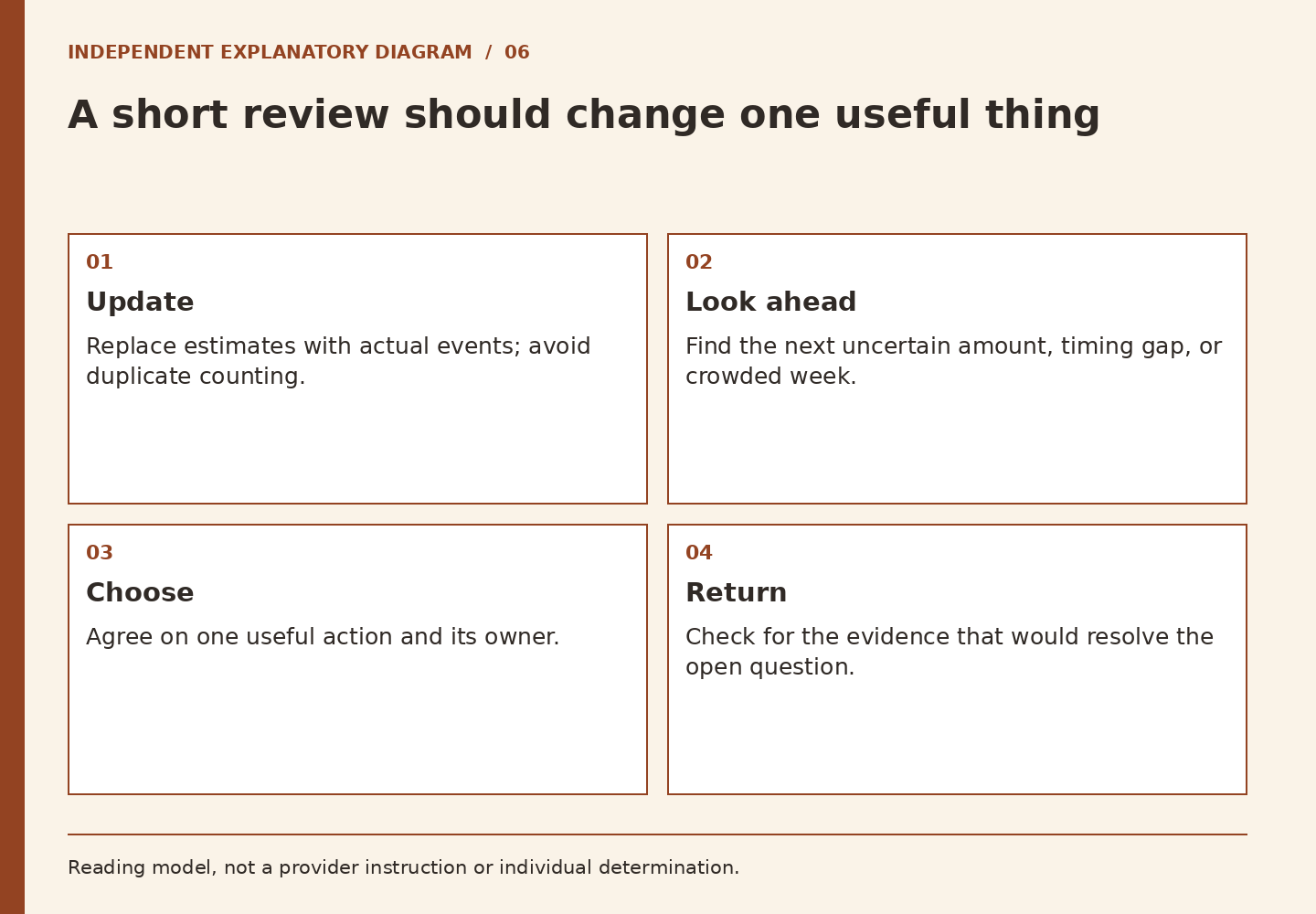
Choose one action with an owner
End with the most useful next action: ask a biller about a date, clarify an expected payment, revise an estimate, or discuss a shared contribution. Name who will do it and the next appropriate checkpoint. Do not assign another adult a task without agreement. If the action requires authority over an account, keep that decision with the account holder through the proper process.
Keep the review note short enough to find next time. Three lines can be sufficient: what changed, what remains uncertain, and what happens next. Avoid recording passwords, card numbers, or a detailed financial history on a shared calendar. The underlying documents can remain where you normally keep them securely; the calendar only needs a pointer to the relevant information.
After a few reviews, ask whether the routine is catching useful issues. If it repeatedly overlooks annual expenses, add a periodic scan. If it spends too long recounting the past, shorten that part and look forward sooner. The review is working when the household can identify its next meaningful decision with less confusion, even when the underlying budget remains tight.
Sources and reading boundaries
Sources checked October 7, 2026. This is a review date, not a policy effective date or an account test.
- CFPB: Your Money, Your Goals toolkit: Public collection of income, expense, cash-flow, and life-event educational tools. General education, not a recommendation for a particular account or an individual financial determination. Page modified April 24, 2026; linked tools have their own older dates. Review basis: Official public page text reviewed.
- CFPB: Bill Calendar: General reason to put bill amounts and due dates together on a calendar. Archived April 2019 educational article. Not used for current processing times, legal deadlines, relief programs, or card features. Review basis: Official indexed archived article text reviewed.